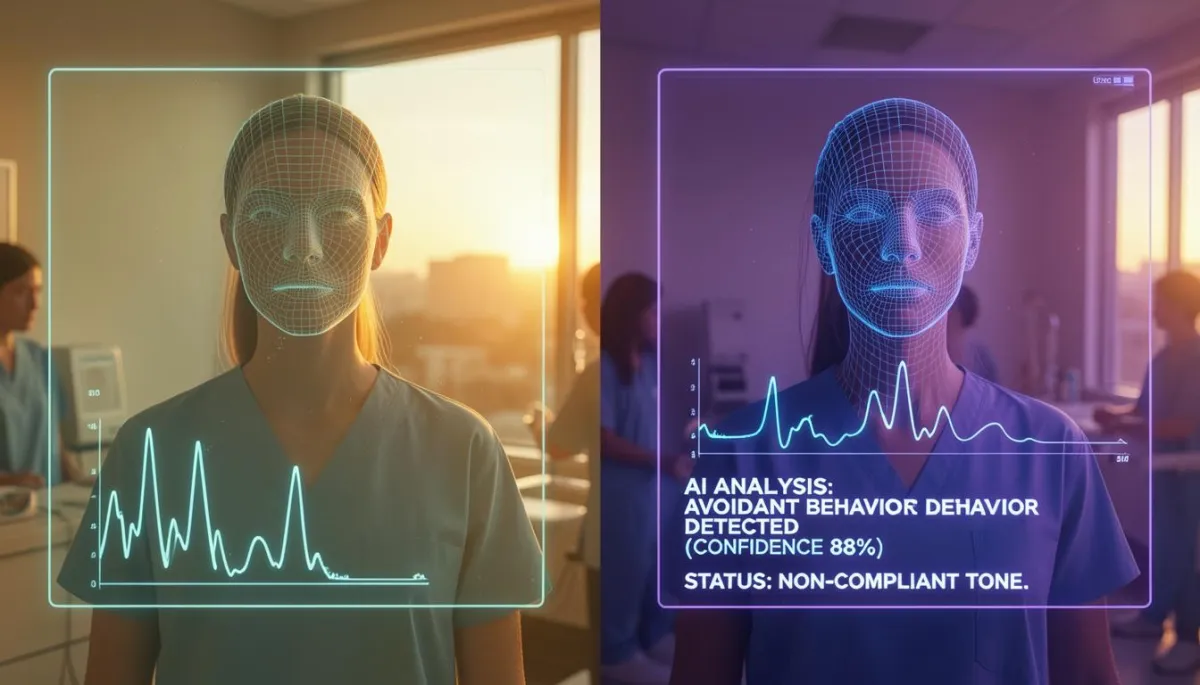
The Judgmental Algorithm? Navigating the Paradox of AI in Mental Health
Why is the promise of "neutral" AI therapy facing a sudden reality check in 2026? For years, the industry narrative suggested that chatbots would provide a "stigma-free" entry point for care because, unlike humans, a machine cannot judge. However, recent findings from the University of Texas at Dallas and a 2026 APA Health Advisory have turned this assumption on its head.
For many navigating the digital health landscape, the lived experience of interacting with a chatbot is proving to be unexpectedly polarizing. While these tools were designed to expand access, new research suggests that users often perceive AI as more judgmental than human clinicians—not because the machine holds a moral bias, but because it lacks "profound comprehension."
The Science: Why "Neutrality" Isn't Enough
The core of the issue lies in the biopsychosocial model of care. Human empathy is not merely the absence of judgment; it is an active, validated understanding of a person's social and emotional context.
1. The Validation Deficit
A study published in MIS Quarterly (December 2025/January 2026) highlights that text-based AI often fails to provide the "deep understanding" required for a functional therapeutic alliance. When a patient shares a vulnerable moment and receives a mathematically optimized response, the lack of genuine resonance can feel like a cold dismissal. In psychological terms, this is a failure of "attunement"—the process by which a provider aligns their emotional state with the client's.
2. The Stigma of "Average" Data
Further complicating this is a 2026 Stanford study revealing that Large Language Models (LLMs) can inadvertently mirror societal stigmas found in their training data. Researchers found that AI models often displayed higher levels of stigma toward complex conditions like schizophrenia or alcohol dependence compared to depression.
The Statistical Reality: If an algorithm’s training set contains a P-value indicating a high correlation between certain conditions and negative social outcomes, the AI may "hallucinate" judgmental or stereotypical advice unless rigorously governed by clinical guardrails.
The Tech Bridge: AI as the Scribe, Not the Soul
At ProCareTech, we view these findings not as a reason to abandon technology, but as a call to "right-size" its role. The Tech Bridge is most effective when it supports the clinician's ability to be human, rather than trying to mimic humanity itself.
Ambient Clinical Listening: Instead of replacing the therapist, AI "scribes" are now saving clinicians thousands of hours in documentation. This allows the provider to maintain eye contact and deep presence—the very things a chatbot lacks.
Augmented Triage: AI excels at "digital health literacy," helping patients organize their symptoms and data before they enter the room. This transforms the patient from a passive recipient into an informed partner in shared decision-making.
The Practicality: The News You Can Use
As a provider or a patient, how do you navigate this "judgmental" AI landscape? Here is the "news you can use" for modern practice:
For Clinicians: The "Human-in-the-Loop" Mandate. Never use AI as a standalone diagnostic tool. Use it to flag "vocal prosody" or mood shifts, but always filter those insights through your own clinical intuition.
For Patients: Use AI for Information, Not Validation. Treat chatbots as sophisticated "interactive encyclopedias." They are excellent for explaining a diagnosis or a medication’s side effects, but they cannot replace the "safe space" of a human relationship.
Audit Your Tools: Ensure any digital wellness platform you use is transparent about its "clinical guardrails." The APA now recommends specifically looking for tools that have been "rigorously benchmarked" against psychological safety standards.
The Bottom Line: Technology is a force multiplier for rational thought and administrative efficiency, but empathy remains a uniquely biological achievement.
Information is a powerful tool. By applying these evidence-based strategies, we contribute to lasting progress in a world where technology and psychology must walk hand-in-hand.
Learn more about our Services.

